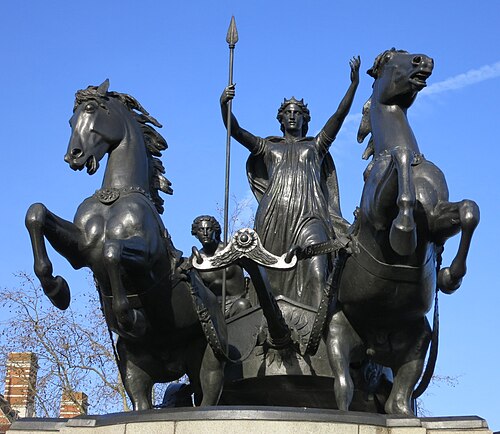
Caratacus, Boudica, and the Druids of Anglesey
The Roman conquest succeeded in its first season. Holding the country took twenty years of intermittent war. The pattern was familiar across the empire: defeat the king, reduce the hillfort, install a garrison — and then deal with the next king, who has not yet learned the lesson. In Britain three names mark the worst of that fighting: Caratacus, the priests of Anglesey, and Boudica.
Caratacus and the Welsh Marches
After the Medway, Caratacus fled westward to the Silures and Ordovices of Wales and waged guerrilla war from the hills. For nearly a decade he tied down whole legions. The governor Publius Ostorius Scapula brought him to a pitched battle in AD 50, somewhere in the Welsh borders — the site is unknown, though Caer Caradoc in Shropshire is traditional — and finally beat him.
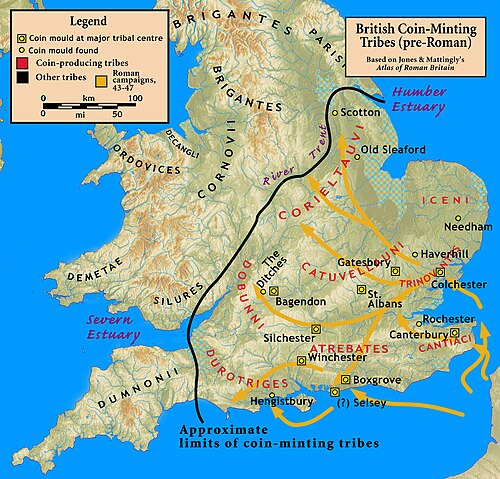
Caratacus escaped again, this time north to the Brigantes. Their queen, Cartimandua, was a Roman client. She bound him in chains and handed him to her allies. Brought to Rome to be paraded in a triumph, Caratacus is said by Tacitus to have addressed the Senate so eloquently that Claudius pardoned him and let him live out his days in Italian comfort. The episode — a defeated barbarian sparing himself by Roman virtue — was exactly the kind of scene Roman audiences loved.
Anglesey, AD 60
By AD 60 the governor Gaius Suetonius Paulinus had pushed across north Wales to the shore of the Menai Strait. On the far side lay Mona — Anglesey — the heartland of British druidism and a sanctuary for refugees from the wars of the previous decade. Tacitus describes the scene with the rhetorical flourish of a writer who was not there: druids on the shore raising their hands to heaven, women in black running among the warriors with torches.
The legions hesitated, then crossed. The grove was cut down, the altars demolished, the priests killed. Druidism as an organised power in Britain effectively ends here. Suetonius, however, had no time to consolidate. A messenger reached him from the southeast: the Iceni were in revolt, and Camulodunum was burning.
Boudica and the Great Revolt
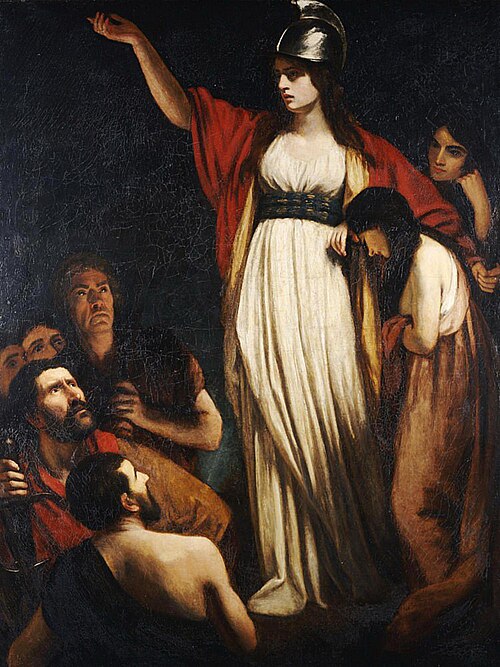
Prasutagus, king of the Iceni in East Anglia, had ruled as a client of Rome. On his death in AD 60 he willed half his kingdom to his daughters and half to the emperor, hoping to preserve his line. Roman procurators read the will as a surrender of the whole. They seized the estates, flogged Prasutagus's widow Boudica, and raped his daughters. The provocation was catastrophic.
Boudica raised the Iceni and the neighbouring Trinovantes. With Suetonius and the bulk of the army on the far side of the country, the rebels stormed Camulodunum and burned its veterans alive in the temple of Claudius. They turned south to Londinium, a young trading town that Suetonius reached, judged indefensible, and abandoned to its fate. They sacked it, then took Verulamium — modern St Albans. Tacitus puts the dead at seventy thousand; Dio Cassius at eighty.
Suetonius gathered some ten thousand legionaries and met Boudica's far larger host on a battlefield of his own choosing — somewhere in the Midlands — with woods at his back and a narrow front. The Roman line held; the British retreat was blocked by their own wagon-train. The slaughter was immense. Boudica, according to one account, took poison; according to another, she fell sick and died.
"We British are used to women commanders in war." — Boudica, in the speech composed for her by Tacitus.
The revolt nearly cost Rome the province. After it, the Romans built more forts and were a little more careful. The age of organised, large-scale British resistance south of the Brigantes was over.