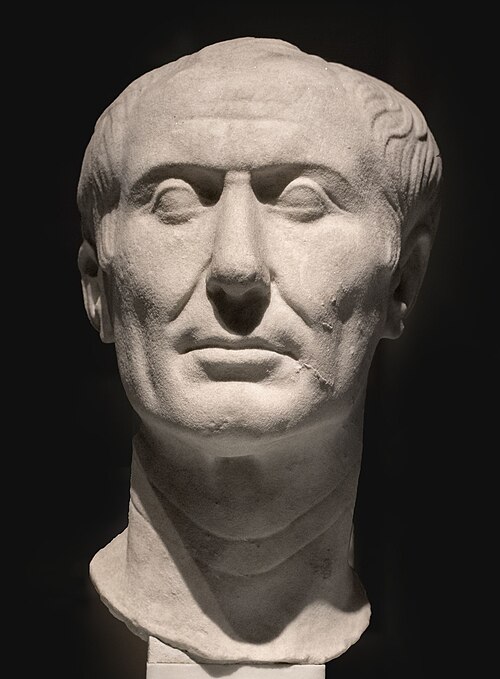
Caesar's Expeditions, 55 and 54 BC
Julius Caesar's two crossings of the Channel were not, strictly, a conquest. They were demonstrations — of reach, of will, of the long arm of Rome — mounted as a side-campaign to the Gallic Wars. Neither expedition founded a province. Both, however, fixed Britain in the Roman political imagination as a place that could, in principle, be taken.
The First Crossing, 55 BC
Caesar's stated motive was that the Britons had aided the Gauls. The deeper motive was prestige. In late August 55 BC he crossed from Portus Itius with two legions — about ten thousand men — and made an opposed landing on the Kentish coast, probably near Walmer or Deal. The Britons met him at the shore with cavalry and chariots; the legions waded ashore under fire from the standard of the Tenth.
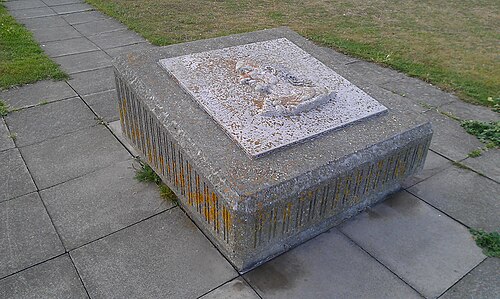
The campaign that followed was brief and inconclusive. A storm scattered the supporting cavalry transports and damaged the warships drawn up on the beach. Without the cavalry he could not pursue, and without secure ships he could not winter. Caesar accepted hostages from the local chieftains and recrossed to Gaul before the equinox.
The Second Crossing, 54 BC
The second expedition was a far larger affair: five legions and two thousand cavalry, carried in some eight hundred ships. This time the landing was unopposed. Caesar marched inland, forced the Thames, and stormed the stronghold of Cassivellaunus, the war-leader of the British coalition. Cassivellaunus sued for peace, gave hostages, and agreed to a tribute.
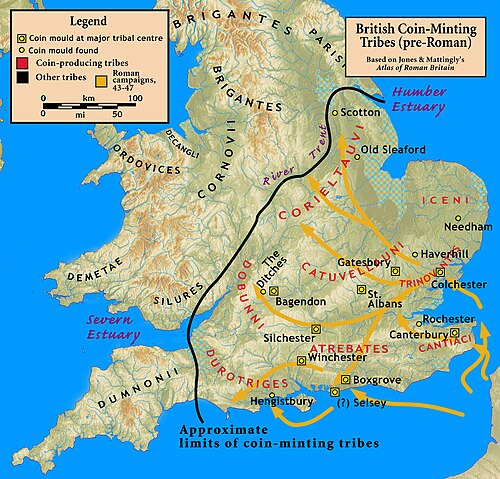
Yet Caesar again left the island before winter. Trouble in Gaul demanded his return, and he never came back. The settlements he imposed — tribute, hostages, the recognition of certain client kings — outlived him in form if not in substance. Roman tribute was rarely paid; British coinage in the following century shows that some kings styled themselves with Latinised titles, evidence less of submission than of trade.
The Long Pause, 54 BC to AD 43
Almost a century separated Caesar's withdrawal from the next Roman boots on British soil. Augustus contemplated invasion three times (in 34, 27, and 25 BC) and each time turned aside. Caligula in AD 40 staged a bizarre expedition to the Channel coast that may have been preparation, propaganda, or madness, and that ended without a crossing.
"The Britons themselves submit readily to slavery; it is only against the unconquered that this island is invincible." — Tacitus, paraphrased.
What Caesar had really established was a precedent: that Britain belonged, in some imperial sense, to Rome's future. When Claudius came to the throne in AD 41 looking for a triumph that would secure his shaky position, Britain was already on the map.