The Claudian Invasion, AD 43
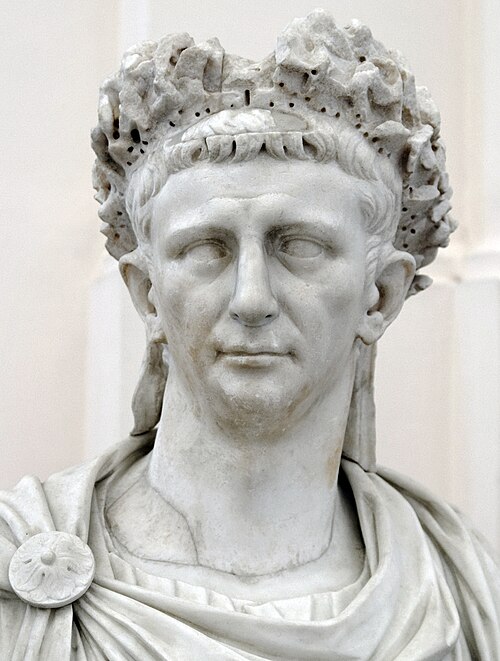
Claudius came to the purple in AD 41 by accident, dragged from behind a curtain by the Praetorians after the murder of Caligula. He was elderly, scholarly, and widely held to be a fool. He needed a triumph — a real military victory that would silence the Senate and make him an emperor in his own right. He chose Britain.
The Pretext and the Force
The pretext was a deposed king. Verica, ruler of the Atrebates in southern Britain, had been driven out by the expansionist Catuvellauni and had fled to Rome as a suppliant. Claudius's response was an invasion force of four legions — the Second Augusta, the Ninth Hispana, the Fourteenth Gemina, and the Twentieth Valeria — with auxiliaries, a total of perhaps forty thousand men. Command was given to Aulus Plautius, a respected senator. The future emperor Vespasian led the Second Augusta.
The Landing and the Medway
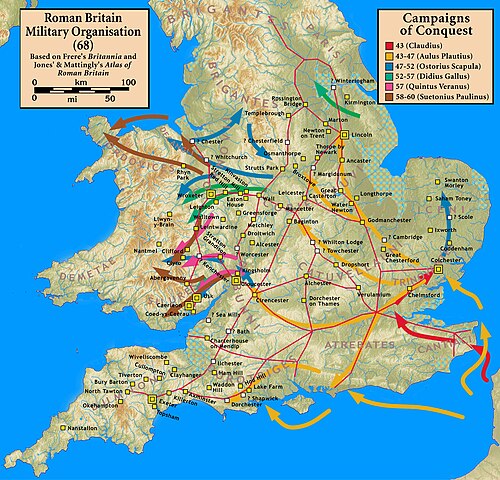
The fleet sailed in three divisions and made landfall most likely at Rutupiae — modern Richborough — in Kent. The Britons, led by Caratacus and Togodumnus, sons of the late Catuvellaunian king Cunobeline, fell back to the line of the river Medway, near present-day Rochester. There the decisive engagement was fought.
The battle of the Medway raged for two days, an unusually long fight by Roman standards. Plautius's Batavian auxiliaries, trained to swim in armour, crossed the river upstream and hamstrung the British chariot horses. A second crossing at the ford, led by Vespasian, broke the British line. Togodumnus died of his wounds shortly afterwards; Caratacus escaped westwards to continue the war from Wales.
The Emperor's Triumph
At the Thames, Plautius halted — under instructions, it seems, to wait for the emperor. Claudius arrived with reinforcements that included war elephants, took nominal command for sixteen days, accepted the surrender of eleven British kings at Camulodunum (modern Colchester), and returned to Rome to celebrate a triumph and the title Britannicus. He had spent perhaps two weeks in Britain.
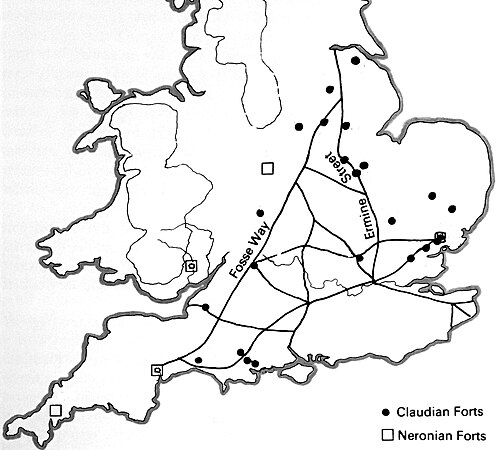
The work of consolidation fell to Plautius and his successors. Camulodunum was made the provincial capital and the seat of an imperial cult. Vespasian's Second Augusta drove southwest, storming hillforts — Suetonius credits him with reducing more than twenty — as far as the Isle of Wight. Other columns pushed north and west. By AD 47, Roman authority ran along the Fosse Way, the line that would form the province's first internal frontier.
The Claudian invasion was, by Roman standards, an unusually clean conquest of its initial objective. The harder work — pacifying Wales, holding the north, surviving the rage of the tribes who had not yet fought — was still to come.