Agricola, the Walls, and the Long Withdrawal
The Boudican revolt nearly broke Roman Britain. The two decades that followed mended it, and then went further than any Roman force had gone before. The story of the late first century is the story of Gnaeus Julius Agricola, governor from AD 78 to 84 and the high-water mark of Roman ambition in the north.
Agricola in Caledonia
We know Agricola's career in unusual detail because his son-in-law, the historian Tacitus, wrote his biography. Whether the picture is accurate or flattering, the bones of the campaigns are clear enough: Agricola completed the conquest of Wales in his first season, secured the Brigantes in his second, and pushed the frontier north of the Tyne by his third. His fleet circumnavigated Britain and proved, for the first time in Roman knowledge, that it was an island.
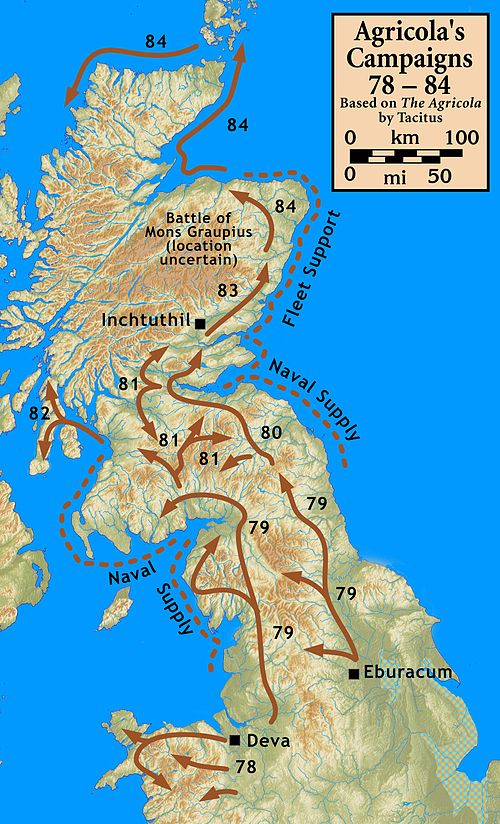
In AD 84 he met the assembled Caledonian tribes under their war-leader Calgacus at Mons Graupius, somewhere in the northeast of modern Scotland. The Roman line, anchored on auxiliary infantry, broke the Caledonian charge; the Roman cavalry then swept the field. Tacitus claims ten thousand Britons fell to fewer than four hundred Romans — a ratio to be taken with a grain of Roman salt. What is certain is that the Caledonian field army was destroyed.
And then Agricola was recalled. Domitian, the new emperor, needed troops on the Danube. The fortress at Inchtuthil, designed to garrison the Highlands, was dismantled before it could be occupied. Within a few years the Roman frontier had fallen back to the Stanegate, the line of forts between Carlisle and Corbridge. Tacitus's bitter judgement: perdomita Britannia et statim missa — "Britain was thoroughly conquered, and immediately let go."
Hadrian's Wall
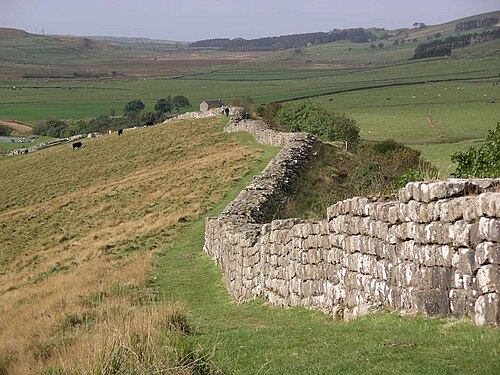
In AD 122 the emperor Hadrian came to Britain in person. The frontier was unsettled; raids from the north had cost lives. Hadrian's solution, characteristic of his reign, was a wall: seventy-three miles of stone and turf from the Solway to the Tyne, with a fort every Roman mile, ditches in front and behind, and gates that controlled who entered the empire and who left it. It was finished within about a decade.
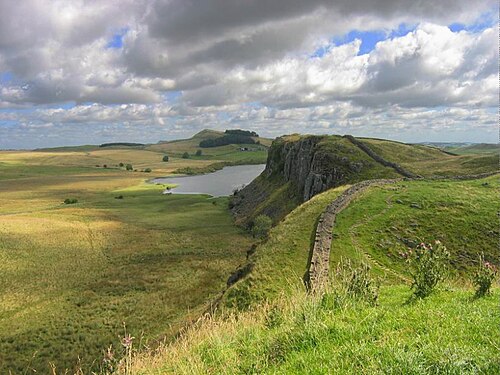
The wall was not impassable; it was not meant to be. It was a customs barrier, a watch-line, and a statement. To the people on either side it said the same thing: this is the edge.
Antoninus Pius, Hadrian's successor, did not like the statement. In AD 142 he ordered his governor Lollius Urbicus to advance the frontier a hundred miles north, to a turf rampart between the Forth and the Clyde. The Antonine Wall lasted twenty years before it was abandoned. The legions fell back to Hadrian's line and stayed there.
Severus and the Last Campaigns
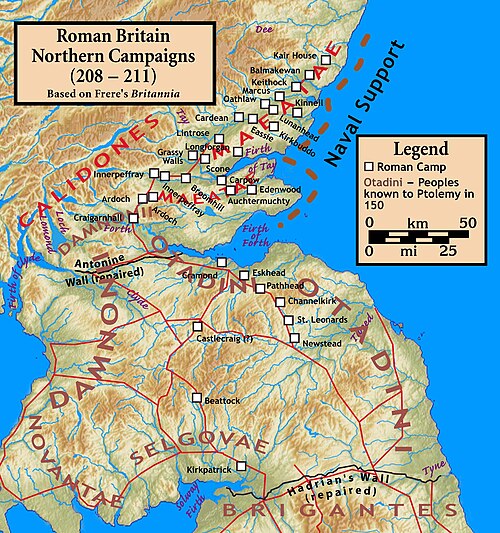
The emperor Septimius Severus brought the imperial court to York in AD 208 and campaigned into Caledonia for three years with savage thoroughness. Cassius Dio describes a scorched-earth war of attrition that cost Rome perhaps fifty thousand dead, mostly to disease and ambush rather than open battle. Severus died at York in AD 211. His sons Caracalla and Geta concluded a peace, withdrew to Hadrian's Wall, and turned their attention to murdering one another for the throne.
That was the last serious Roman attempt to push the frontier north. Britain entered the third and fourth centuries as a stable, prosperous province defended by the wall, the fleet, and a network of coastal forts against a new threat: Saxon raiders from across the North Sea.
The End
In AD 410, with the empire reeling from the sack of Rome by Alaric and the collapse of the Rhine frontier, the emperor Honorius wrote to the cities of Britain telling them to look to their own defence. There was no formal end, no last legion marching for the boats. The province simply slipped from Roman hands — the towns shrinking, the coinage drying up, the villas falling silent — over a generation.
"The groans of the Britons" — Gildas, writing more than a century later, called the years after the legions left.
What remained was infrastructure: roads that became the King's highway, walls that became cathedrals, towns that became counties. And one wall, in the north, still standing.