An Empire Reaches the Edge of the World
To the Romans, Britain lay beyond the known world — a fog-bound island of warring tribes, druidic groves, and rumoured mineral wealth. The conquest of this land was not a single event but a long, uneven process spanning more than four centuries, beginning with Julius Caesar's reconnaissance in 55 BC and ending with the formal withdrawal of Roman authority around AD 410.
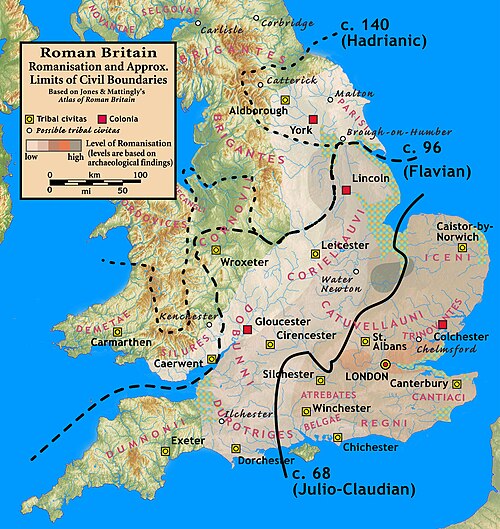
The decisive invasion came under the emperor Claudius in AD 43, when four legions under Aulus Plautius landed in Kent. Within a few years the southeast was under direct rule; within a generation, the legions had pushed into Wales and the north. By the close of the first century, governor Gnaeus Julius Agricola had marched as far as the Highlands, defeating the Caledonians at Mons Graupius in AD 84.
What followed was a slow contraction. The empire could conquer Britain, but it could not afford to hold every corner. Hadrian's Wall, begun in AD 122, marked the line where ambition met arithmetic. Later emperors pushed north again — only to fall back. The province of Britannia endured for some three hundred years, profoundly Romanised in its towns and roads, but always bordered by a frontier that would never quite close.
A Brief Timeline
- 55 & 54 BC Julius Caesar crosses the Channel twice during the Gallic Wars, taking hostages and tribute but establishing no permanent foothold.
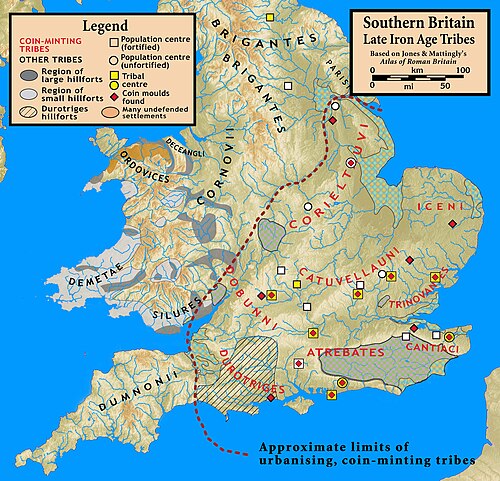
- AD 43 Emperor Claudius authorises the full invasion. Aulus Plautius lands in Kent; the Catuvellauni are defeated at the Medway.
- AD 47–60 Roman authority extends to the Fosse Way; campaigns push into Wales under Ostorius Scapula and Suetonius Paulinus.
- AD 60–61 Boudica, queen of the Iceni, leads a revolt that destroys Camulodunum, Verulamium, and Londinium before being crushed.
- AD 78–84 Agricola completes the conquest of Wales and pushes into Caledonia, winning the battle of Mons Graupius.
- AD 122 Hadrian visits Britain; construction begins on Hadrian's Wall, fixing the northern frontier.
- AD 142 Under Antoninus Pius, the frontier is briefly advanced to the Antonine Wall between the Forth and Clyde.
- AD 208–211 Septimius Severus campaigns in Caledonia, but his death at York forces a return to Hadrian's Wall.
- AD 410 Honorius tells the British cities to look to their own defence. Roman rule formally ends.
Why It Mattered
The conquest left an imprint that long outlasted the legions. Roman roads dictated the lines of medieval travel; Roman walls became the spines of medieval cities; Latin survived in the church, the law, and the language of learning. The villas and forums of Britannia were the first urban civilisation the island would know.
And yet, the limits of the conquest mattered just as much. The Caledonians in the north were never truly subdued; the Irish were never even attempted. The province ended at a wall, and that wall — not the legion — became the lasting symbol of Rome in Britain.
"They make a desert and call it peace." — the Caledonian chieftain Calgacus, as imagined by Tacitus on the eve of Mons Graupius.